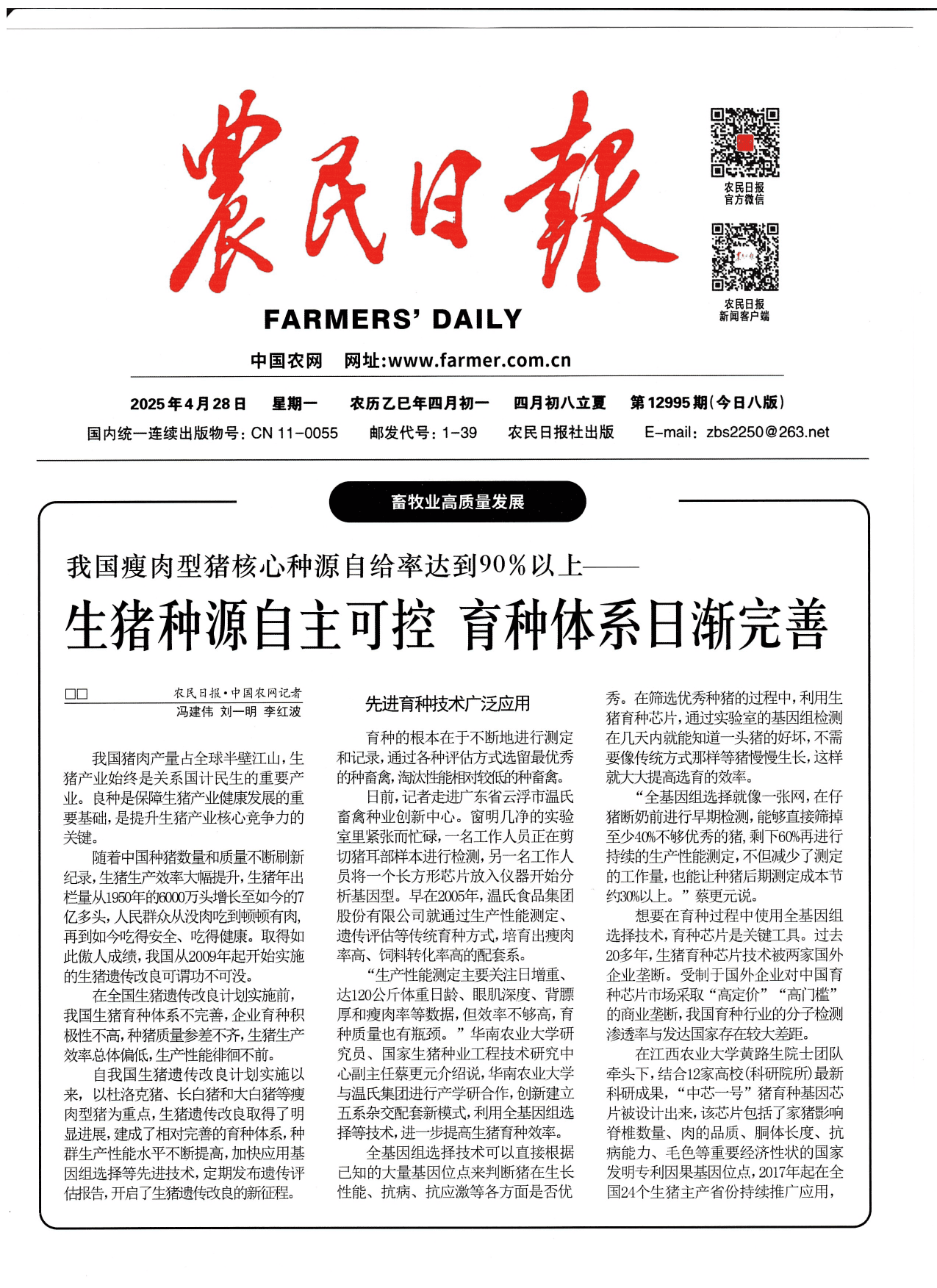
Originally published in Farmers’ Daily on April 28, 2025. The text below is adapted from the OCR-corrected newspaper layout.
Core lean-type pig genetics in China are now more than 90% self-supplied
China produces roughly half of the world’s pork, making the swine sector a foundational industry tied directly to national livelihood. Strong breeding stock is essential both for healthy industry development and for improving long-term competitiveness.
The report notes that since China launched its swine genetic-improvement programme in 2009, breeding systems around lean-type lines such as Duroc, Landrace and Yorkshire (Large White) have steadily improved. Population performance has continued to rise, and advanced methods such as genomic selection are being applied more widely.
Advanced breeding technology is moving into broader use
The article notes that swine breeding chips are a key tool for expanding whole-genome selection. The Zhongxin No. 1 chip has been promoted continuously, while domestic solid-phase breeding chips have helped lower testing costs even further.
The report specifically mentions Chifeng Best Genetics Technology Co., Ltd., which has accumulated birth-registration data for one million pigs and more than 100,000 breeding-chip records through long-term breeding work, and has built production-management and breeding-analysis software on top of that foundation.
Breeding is becoming digital, intelligent and full-chain
At Best Genetics’ farms, every pig is assigned a relatively complete data profile that includes pedigree, health and growth-performance records. With automated measurement equipment and software systems, the company collects multi-dimensional data such as temperature, humidity, carbon dioxide and body weight, then uses big-data analytics to identify pigs with different strengths.
Citing expert opinion, the article says that collaborative breeding across the full industry chain is becoming an important direction for China’s seed industry. In the future, artificial intelligence, machine vision and big-data computing are expected to play an even larger role in phenotype collection, genetic evaluation and decision support.